Kyubey (Tokyo, Japan)
Kyubey
2-2-1 Nishi-Shinjuku, Shinjuku-ku, Tokyo 160-0023
03.3344.0315
www.kyubey.jp/keio_e.html
Mon 03/17/2008, 07:40p-09:50p
Kyubey. It's name is synonymous with sushi, and the restaurant is arguably the most famous sushi restaurant in all of Japan. Kyubey is perhaps best known as the inventor of the gunkan-maki, or warship roll. Its creation significantly expanded the repertoire of ingredients used in sushi, such as uni and ikura. The original Kyubey is located in Ginza, but the restaurant has since expanded to several locations throughout Tokyo. Although I would've liked to have visited the Ginza restaurant, time was a constraint, so we decided to dine at the Keio Plaza location in Shinjuku instead. Fortunately, from what I hear, the quality is fairly comparable among locations.
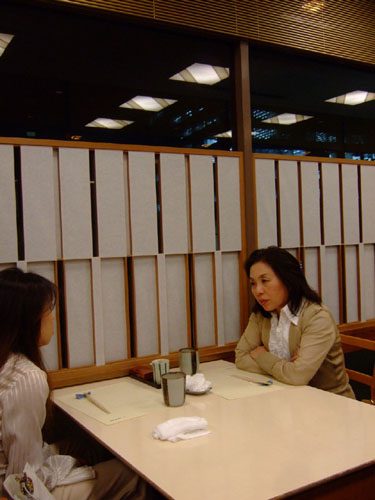
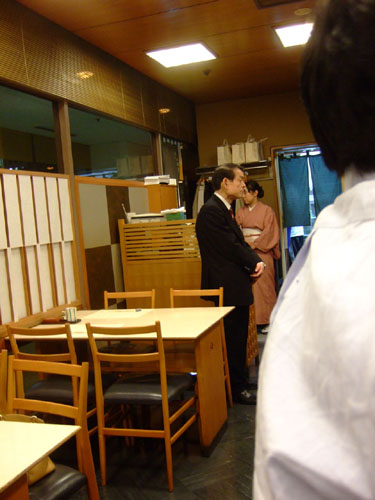
The restaurant is small, with three tables seating about a dozen people. Of course, we didn't come all this way to eat at a table...
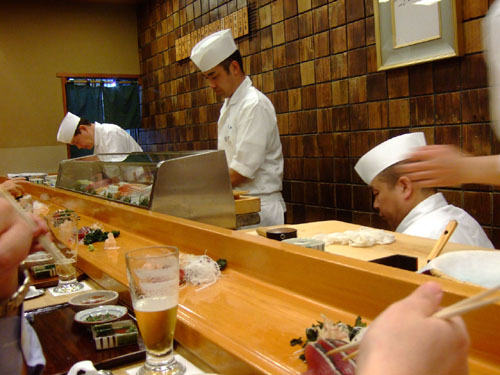
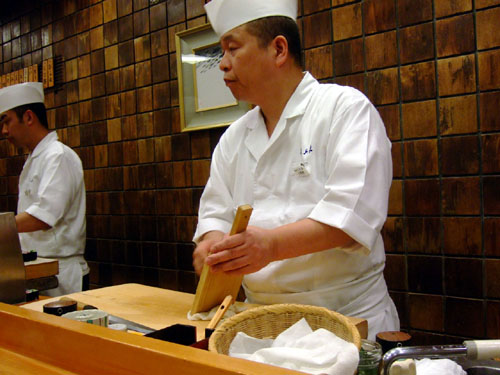
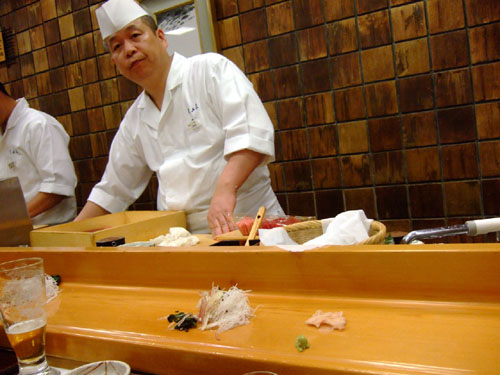
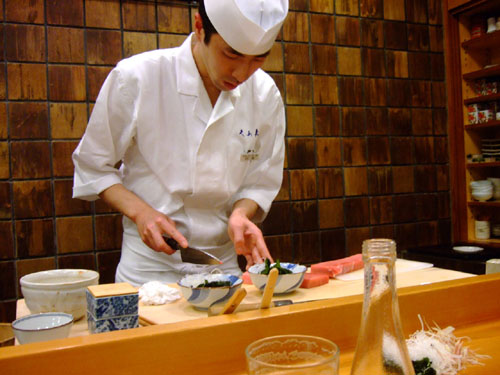
The bar is where the action is. It seats thirteen, of which my party took eight of the seats. Apparently the fellow in the last photo is the head chef.
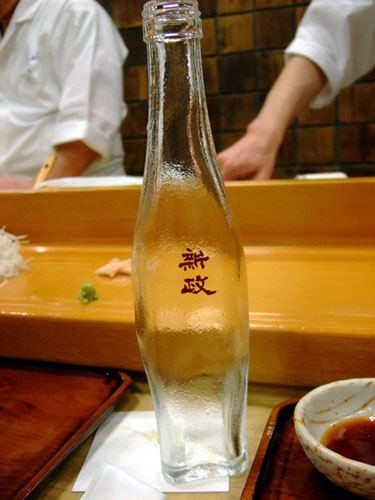
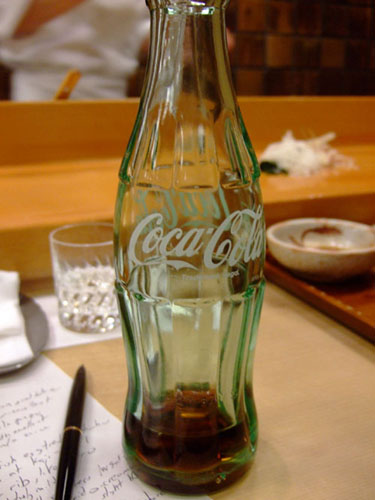
We started with beer, then moved on to sake. One of my dining companions, who doesn't drink, enjoyed a Coke; I tried a sip, and it does taste different than what we have in the US. Humorously, he had originally ordered a Diet Coke, but was chided by the wait staff for doing so. I'm not sure why, as Diet Coke is available in Japan, though it's not nearly as popular as in the US.
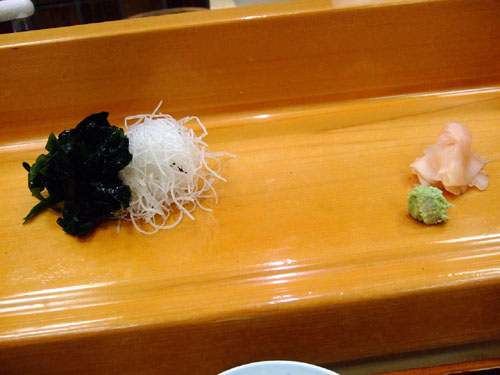
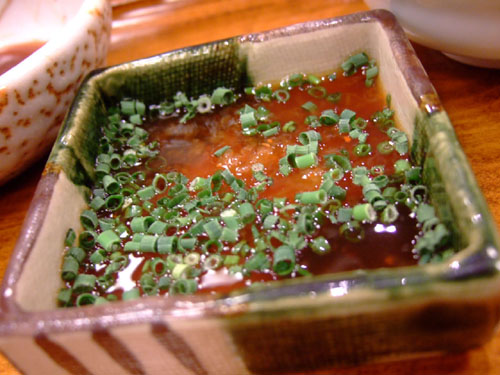
On the counter in front of us sat mounds of seaweed, daikon, ginger, and freshly grated wasabi. We were also given what I believe was a miso-ponzu sauce with scallion. Soy sauce was also poured of course.
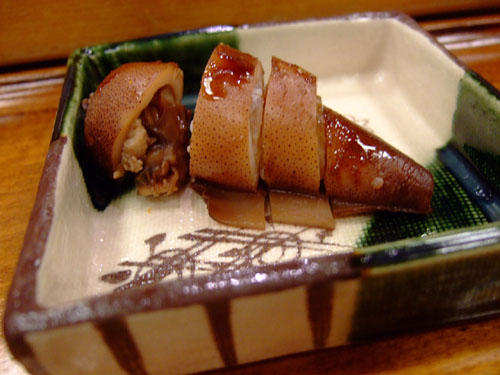
1: Iidako
This was baby octopus, in a sweet sauce. A fitting way to start the meal.
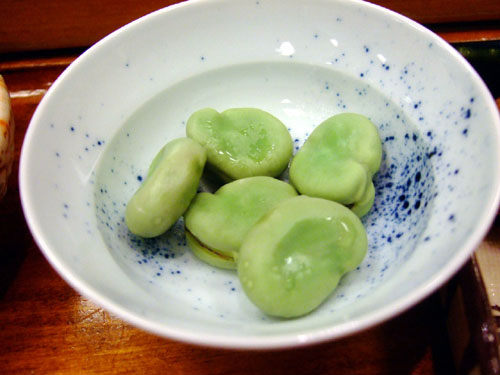
2: Fava Beans
Crisp and crunchy, though not as flavorful as those I had at Kaji the night earlier.
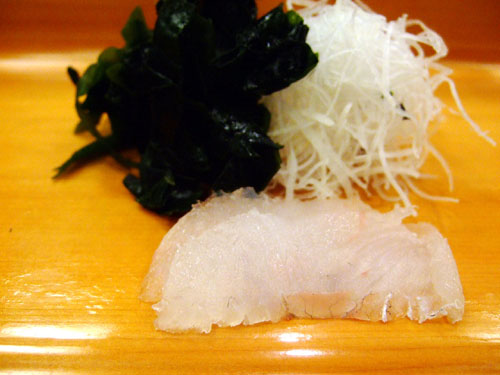
3: Hirame
Over here in the States, hirame generally refers to halibut. However, it really means any flat whitefish, such as fluke or flounder. I don't think this was halibut, but I can't be sure; I should've asked. In any case, it had a pleasing taste and a nice firmness to the flesh.
4: Shima Aji
Unfortunately I was busy eating and forgot to snap a photo. My first time, I swear! I'm not sure if I've had shima aji before; its translation is "striped jack." I found the fish rather mild in flavor, which meant it took very nicely to the sauce.
5: Tai
Naturally grown snapper, or sea bream. Great texture and signature tai flavor. Sadly, I forgot to take a photo here as well.
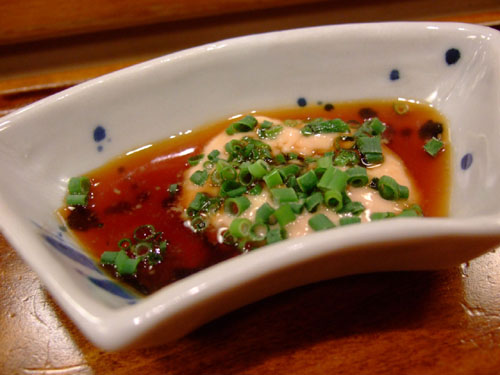
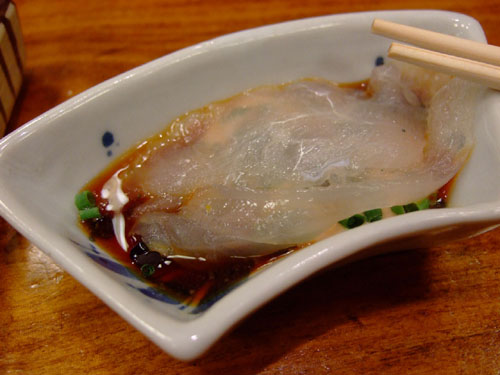
6: Kawahagi
Not only had I never had this fish before, I hadn't even heard of it. I get a translation of "thread-sail filefish." The fish was served with its liver, and was fantastic, one of my favorites of the entire meal actually. Apparently, kawahagi is used as a substitute for fugu when the latter is out of season. Indeed, its crisp, clear flesh is very similar to that of blowfish.
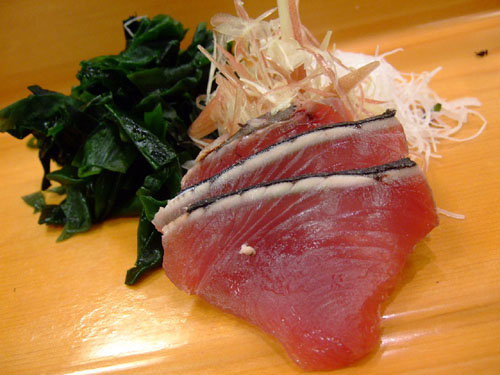
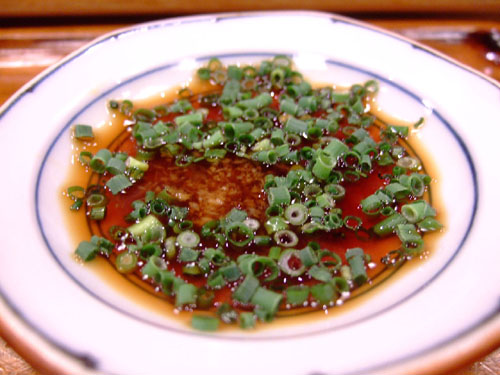
7: Katsuo
This was bonito served with shredded myoga (a crisp, tart vegetable) and a special garlic ponzu. The fish had a slight fishiness thanks to the skin. However, when dipped in the sauce, those flavors faded and gave way to a delicious interplay between the ponzu and the katsuo's beautiful red flesh. Very nice.
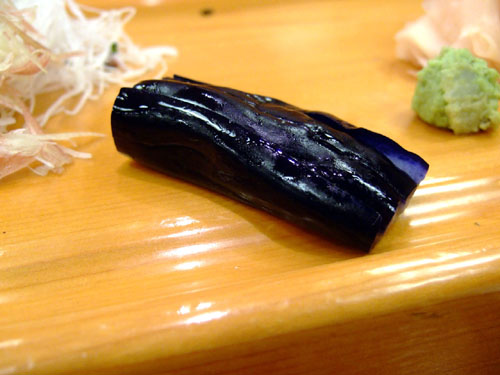
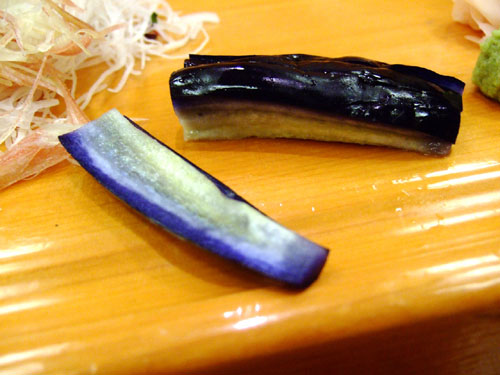
8: Eggplant
I've never had eggplant served at a sushi restaurant before. It was a bit odd, and seemed out of place, but the eggplant was crisp and tart, and I didn't mind it.
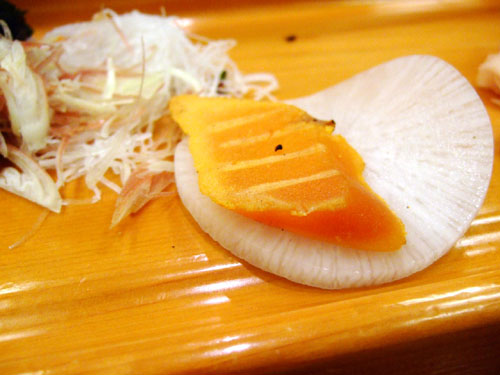
9: Karasumi, Daikon Chip
Karasumi two days in a row! I had it at Kaji the night before. In this case, the mullet fish roe was treated with shochu. Compared to the version at Kaji, which was cooked in a hot pot, this was bolder, saltier, and purer in flavor. Surprisingly good.
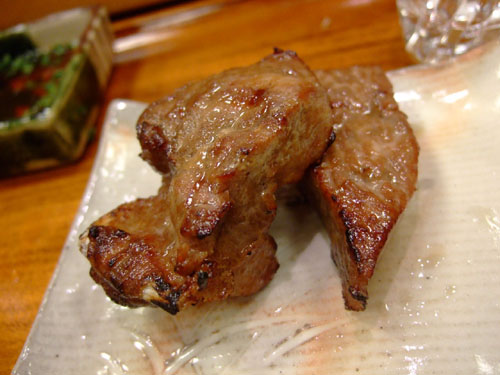
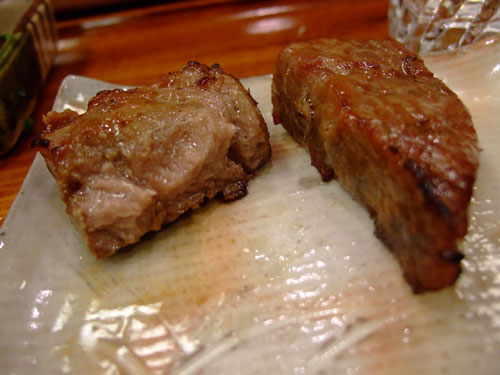
10: Maguro "Spare Ribs"
Tuna cooked "on the bone." This was actually toro-like in nature. The fish was extraordinary rich, fatty, and flavorful, almost like beef instead of tuna. This was my favorite course of the night, and probably my favorite of this entire trip! This may very well be the most flavorful piece of fish I've ever eaten.
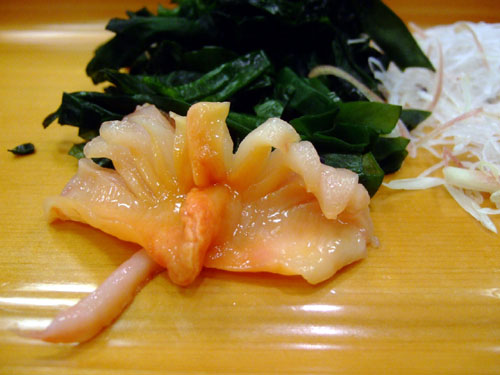
11: Akagai
This is known in English as ark shell or red clam, with the red coming from the large amount of hemoglobin that the flesh has. Apparently, akagai is best in the summer months, after the clam lays its eggs. I found it to be relatively mild compared to other types of clam, including the aoyagi below.
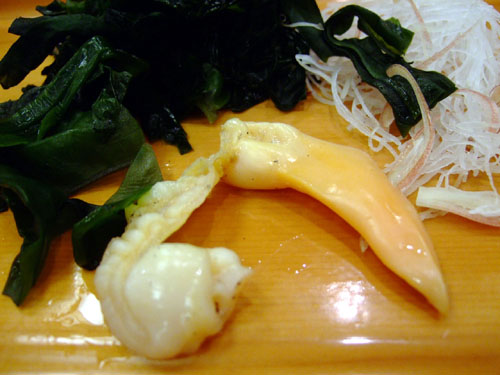
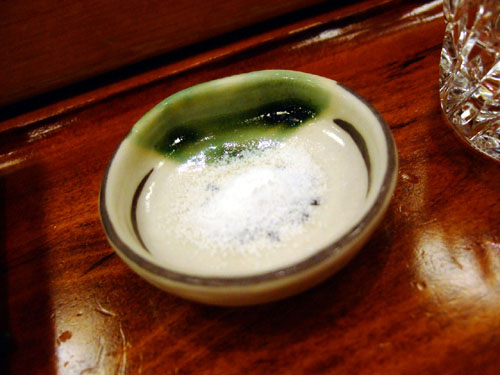
12: Aoyagi
Aoyagi is translated into round clam or hen clam. Unlike other examples I've had, which were very briny, I found this aoyagi to have a delectable subtle sweetness. The clam was good on its own, but the included salt provided a nice contrast.
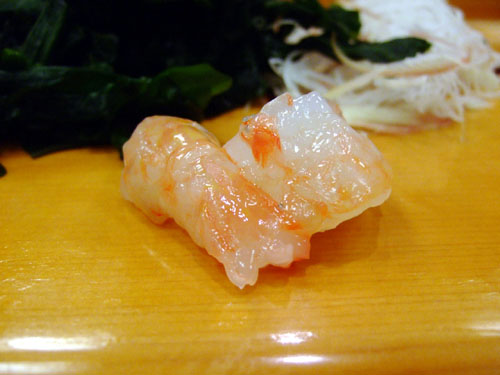
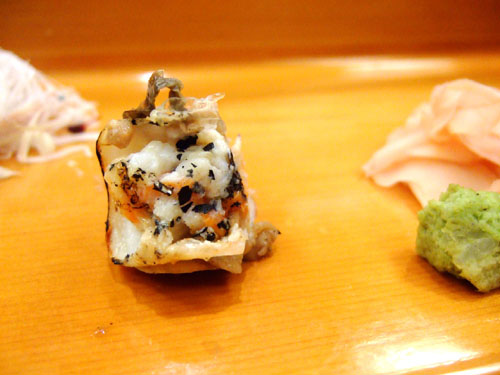
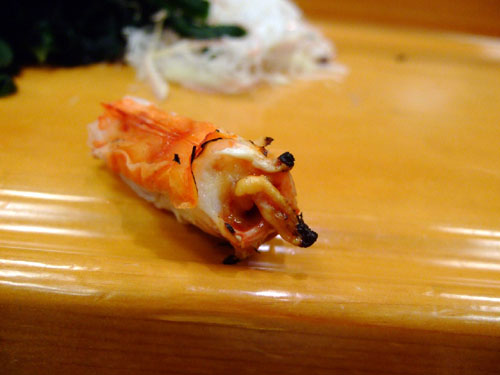
13: Ama Ebi
Sweet shrimp from Hokkaido. These were extremely creamy and almost sticky in texture. Very fresh. Afterwards, we were given the fried heads, which had charred exteriors giving way to soft, gooey insides.
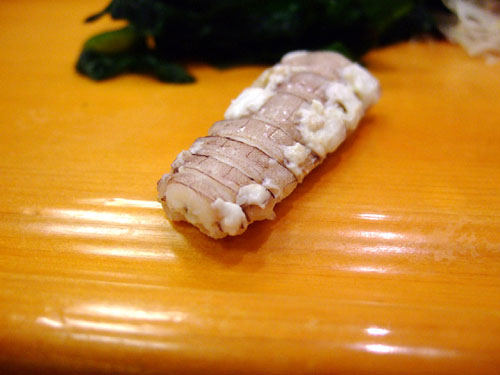
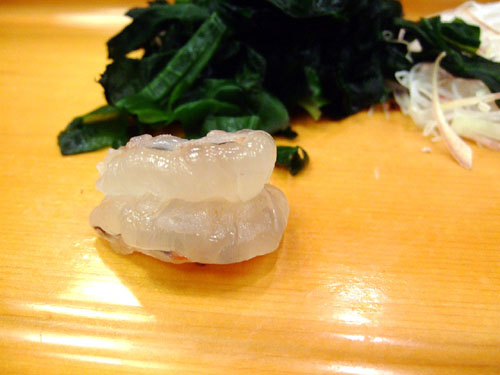
14: Shako
This was a first for me. I don't think I've ever seen shako (a.k.a. squilla or mantis shrimp) in the States. I found this not dissimilar from cooked shrimp, though perhaps a touch brinier.
15: Kurama Ebi
Next, we have another type of raw shrimp, which I'm told is one of the most prized and expensive prawns in Japan. These were killed right in front of us prior to serving, so freshness was assured. And in fact, they were still moving for some time afterwards! That's why they're sometimes also known as "odori ebi," or dancing prawn. The flesh was much firmer and crisper compared to the creamy ama ebi above, which I preferred. The cooked heads burst with flavor in the mouth.
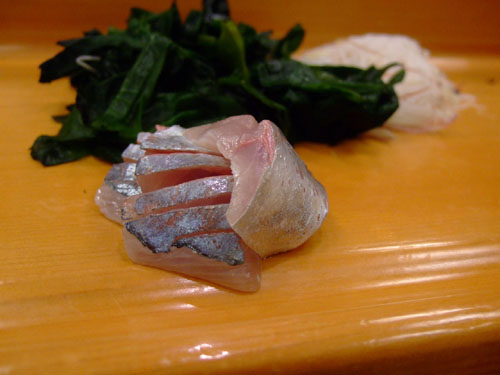
16: Sawara
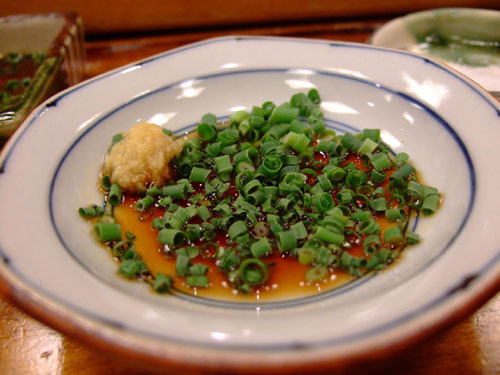
A generous helping of Spanish mackerel served with its own special ginger ponzu. I thought this was quite mild for mackerel actually. The ponzu went great with the fish but I ended up enjoying many of the pieces sans sauce.
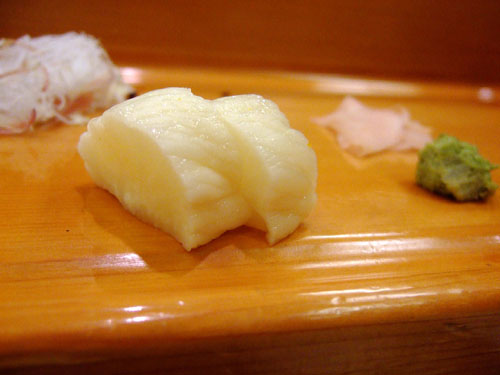
17: Pickled Daikon
Now here's something else I've never experienced at a sushi bar. The daikon was very firm and crunchy in texture, with a slightly acerbic taste. Not bad. This was useful as a palate cleanser of sorts.
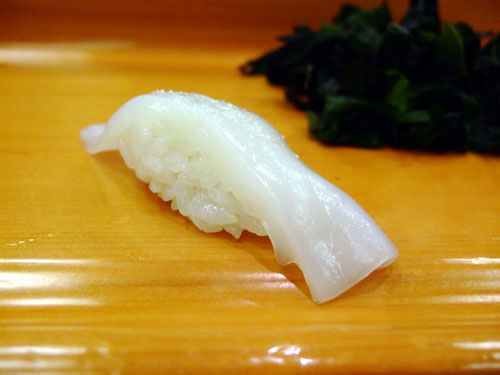
18: Ika
Squid. Great texture on this one, a perfect cross between crispy and creamy, with a mildly briny taste that just coats the tongue.
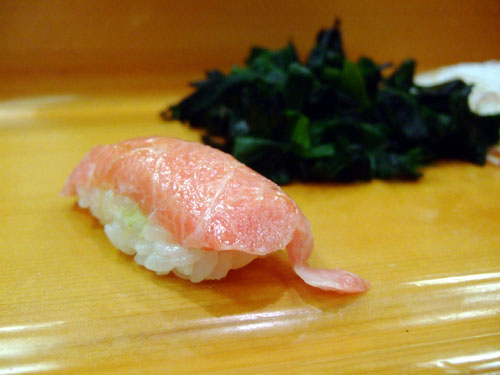
19: Otoro
Look at that marbling; talk about melt-in-your-mouth! So rich, so oily, so soft, so fatty, this may very well be the best toro I've ever experienced, and at 3000 yen a piece (about $30), it should be.
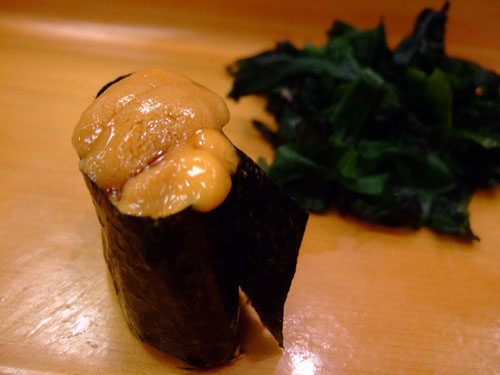
20: Uni
I thought this was a strong example of uni: mild yet still possessing that signature uni flair. Note its rather liquid-y appearance. I was told that the reason for this was that it didn't contain certain preservatives that typically prevent uni from becoming watery.
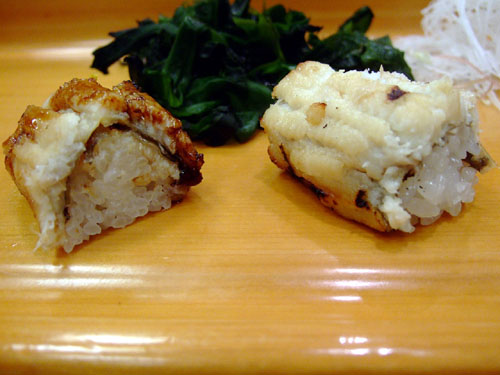
21: Anago
Conger Eel, served two ways, one with sweet sauce and one without. I actually preferred the version without, as it placed more of an emphasis on the eel flavor itself. Often times in the US, I feel that sauce is too liberally applied to eel. As an interesting aside, I was told that unagi (freshwater eel) isn't traditionally used in Edo-style sushi, since it's much oilier and richer than its saltwater cousin.
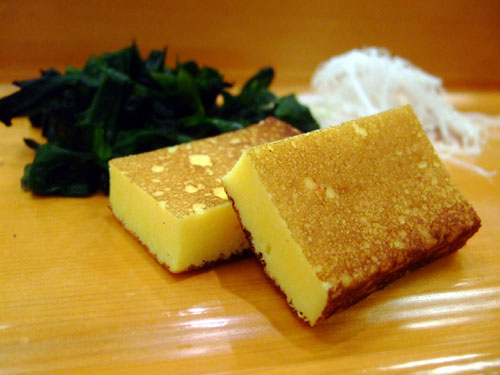
22: Tamago
A very unique looking tamago. It was slightly sweet, with a light, spongy texture, almost like a cake.
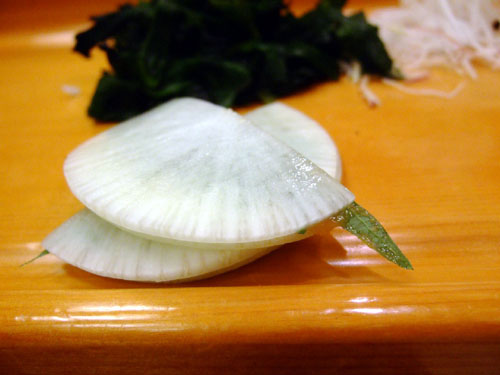
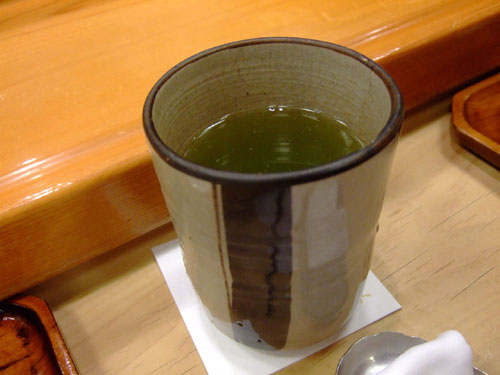
23: Shiso, Plum Paste, and Daikon Sandwich
The daikon gave this dish a crisp texture that complemented the mintiness levied by the shiso, while the plum provided a contrasting sweetness. A hot cup of green tea was a satisfying closure to the meal.
Kyubey is considered the epitome of sushi restaurants in Japan, and indeed, it did not disappoint this night. I was able to experience fish and flavors that had previously never touched these lips. Truly, this was one of the top sushi experiences of my life. And truly, such prowess and perfection doesn't come cheap. If my memory serves me, this was my second costliest sushi meal ever, behind Urasawa of course. But like Urasawa, it was worth every penny (or yen).
2-2-1 Nishi-Shinjuku, Shinjuku-ku, Tokyo 160-0023
03.3344.0315
www.kyubey.jp/keio_e.html
Mon 03/17/2008, 07:40p-09:50p
Kyubey. It's name is synonymous with sushi, and the restaurant is arguably the most famous sushi restaurant in all of Japan. Kyubey is perhaps best known as the inventor of the gunkan-maki, or warship roll. Its creation significantly expanded the repertoire of ingredients used in sushi, such as uni and ikura. The original Kyubey is located in Ginza, but the restaurant has since expanded to several locations throughout Tokyo. Although I would've liked to have visited the Ginza restaurant, time was a constraint, so we decided to dine at the Keio Plaza location in Shinjuku instead. Fortunately, from what I hear, the quality is fairly comparable among locations.
The restaurant is small, with three tables seating about a dozen people. Of course, we didn't come all this way to eat at a table...
The bar is where the action is. It seats thirteen, of which my party took eight of the seats. Apparently the fellow in the last photo is the head chef.
We started with beer, then moved on to sake. One of my dining companions, who doesn't drink, enjoyed a Coke; I tried a sip, and it does taste different than what we have in the US. Humorously, he had originally ordered a Diet Coke, but was chided by the wait staff for doing so. I'm not sure why, as Diet Coke is available in Japan, though it's not nearly as popular as in the US.
On the counter in front of us sat mounds of seaweed, daikon, ginger, and freshly grated wasabi. We were also given what I believe was a miso-ponzu sauce with scallion. Soy sauce was also poured of course.
1: Iidako
This was baby octopus, in a sweet sauce. A fitting way to start the meal.
2: Fava Beans
Crisp and crunchy, though not as flavorful as those I had at Kaji the night earlier.
3: Hirame
Over here in the States, hirame generally refers to halibut. However, it really means any flat whitefish, such as fluke or flounder. I don't think this was halibut, but I can't be sure; I should've asked. In any case, it had a pleasing taste and a nice firmness to the flesh.
4: Shima Aji
Unfortunately I was busy eating and forgot to snap a photo. My first time, I swear! I'm not sure if I've had shima aji before; its translation is "striped jack." I found the fish rather mild in flavor, which meant it took very nicely to the sauce.
5: Tai
Naturally grown snapper, or sea bream. Great texture and signature tai flavor. Sadly, I forgot to take a photo here as well.
6: Kawahagi
Not only had I never had this fish before, I hadn't even heard of it. I get a translation of "thread-sail filefish." The fish was served with its liver, and was fantastic, one of my favorites of the entire meal actually. Apparently, kawahagi is used as a substitute for fugu when the latter is out of season. Indeed, its crisp, clear flesh is very similar to that of blowfish.
7: Katsuo
This was bonito served with shredded myoga (a crisp, tart vegetable) and a special garlic ponzu. The fish had a slight fishiness thanks to the skin. However, when dipped in the sauce, those flavors faded and gave way to a delicious interplay between the ponzu and the katsuo's beautiful red flesh. Very nice.
8: Eggplant
I've never had eggplant served at a sushi restaurant before. It was a bit odd, and seemed out of place, but the eggplant was crisp and tart, and I didn't mind it.
9: Karasumi, Daikon Chip
Karasumi two days in a row! I had it at Kaji the night before. In this case, the mullet fish roe was treated with shochu. Compared to the version at Kaji, which was cooked in a hot pot, this was bolder, saltier, and purer in flavor. Surprisingly good.
10: Maguro "Spare Ribs"
Tuna cooked "on the bone." This was actually toro-like in nature. The fish was extraordinary rich, fatty, and flavorful, almost like beef instead of tuna. This was my favorite course of the night, and probably my favorite of this entire trip! This may very well be the most flavorful piece of fish I've ever eaten.
11: Akagai
This is known in English as ark shell or red clam, with the red coming from the large amount of hemoglobin that the flesh has. Apparently, akagai is best in the summer months, after the clam lays its eggs. I found it to be relatively mild compared to other types of clam, including the aoyagi below.
12: Aoyagi
Aoyagi is translated into round clam or hen clam. Unlike other examples I've had, which were very briny, I found this aoyagi to have a delectable subtle sweetness. The clam was good on its own, but the included salt provided a nice contrast.
13: Ama Ebi
Sweet shrimp from Hokkaido. These were extremely creamy and almost sticky in texture. Very fresh. Afterwards, we were given the fried heads, which had charred exteriors giving way to soft, gooey insides.
14: Shako
This was a first for me. I don't think I've ever seen shako (a.k.a. squilla or mantis shrimp) in the States. I found this not dissimilar from cooked shrimp, though perhaps a touch brinier.
15: Kurama Ebi
Next, we have another type of raw shrimp, which I'm told is one of the most prized and expensive prawns in Japan. These were killed right in front of us prior to serving, so freshness was assured. And in fact, they were still moving for some time afterwards! That's why they're sometimes also known as "odori ebi," or dancing prawn. The flesh was much firmer and crisper compared to the creamy ama ebi above, which I preferred. The cooked heads burst with flavor in the mouth.
16: Sawara
A generous helping of Spanish mackerel served with its own special ginger ponzu. I thought this was quite mild for mackerel actually. The ponzu went great with the fish but I ended up enjoying many of the pieces sans sauce.
17: Pickled Daikon
Now here's something else I've never experienced at a sushi bar. The daikon was very firm and crunchy in texture, with a slightly acerbic taste. Not bad. This was useful as a palate cleanser of sorts.
18: Ika
Squid. Great texture on this one, a perfect cross between crispy and creamy, with a mildly briny taste that just coats the tongue.
19: Otoro
Look at that marbling; talk about melt-in-your-mouth! So rich, so oily, so soft, so fatty, this may very well be the best toro I've ever experienced, and at 3000 yen a piece (about $30), it should be.
20: Uni
I thought this was a strong example of uni: mild yet still possessing that signature uni flair. Note its rather liquid-y appearance. I was told that the reason for this was that it didn't contain certain preservatives that typically prevent uni from becoming watery.
21: Anago
Conger Eel, served two ways, one with sweet sauce and one without. I actually preferred the version without, as it placed more of an emphasis on the eel flavor itself. Often times in the US, I feel that sauce is too liberally applied to eel. As an interesting aside, I was told that unagi (freshwater eel) isn't traditionally used in Edo-style sushi, since it's much oilier and richer than its saltwater cousin.
22: Tamago
A very unique looking tamago. It was slightly sweet, with a light, spongy texture, almost like a cake.
23: Shiso, Plum Paste, and Daikon Sandwich
The daikon gave this dish a crisp texture that complemented the mintiness levied by the shiso, while the plum provided a contrasting sweetness. A hot cup of green tea was a satisfying closure to the meal.
Kyubey is considered the epitome of sushi restaurants in Japan, and indeed, it did not disappoint this night. I was able to experience fish and flavors that had previously never touched these lips. Truly, this was one of the top sushi experiences of my life. And truly, such prowess and perfection doesn't come cheap. If my memory serves me, this was my second costliest sushi meal ever, behind Urasawa of course. But like Urasawa, it was worth every penny (or yen).
posted by kevinEats at
7:40 PM


28 Comments:
You write very well. I could taste your descriptions.
Thanks! That's basically my goal, to recreate the dining experience, to be sort of the next best thing to actually being there.
Beautiful pictures!
Thanks. It was beautiful food!
Great photos. This meal is well-documented. I love it!
On a similar note, I'm so hungry....
Thanks Chung. Looking through these posts makes me hungry too!
nice post as always.
Just a bit more info on Kawahagi (カフハギ). It mean skin(kawa) remove(hagi). The price of the fish is actully base on the size of it's liver. a non sushi grade run a $1/oz in market. according to wikipedia japan, hawaii state fish Humuhumumukumukuaupaa(triggerfish) has been serve as kawahagi when caugh. Even it been use to replace fugu when it not in season, the best time to eat kawahagi is same as fugu-winter, when the liver of it are the fattest
Thanks for the additional info. I still haven't had kawahagi anywhere else but at Kyubey.
According to www.chowhound.com
Kitsho Cupertino, CA havi Kawahagi.
Kitsho - "My long awaited visit to Kitsho arrived. ... Other items: aji and shima aji, amaebi, kohada, sayori, shako, kinmedai, kibinago, kawahagi, live uni"
And Giapponese in Woodburry, MN also have it.
Ah thanks, but those two locations are so far away. Los Angeles is supposed to be epicenter of sushi in the US, so it's somewhat disappointing that there's no kawahagi to be found here.
I found out through Takayama Masa, he said there lot of sushi bar in LA have kawahagi ( he refuse to say where, and i not going to push since i don't want to be ban) he did say was some product are limit, restaurant like to keep them for reg's omakasa ( newbe will rarely get since the chef don't know your taste yet) or people who can read the Kanji name of the fish written on the woodern brick on the wall.
He suggest is better ask, or call sever day aheard to request it( assume they remenber u)
Thanks for the info. Interesting that he said a lot of restaurants have kawahagi, because I've been to the "best" sushi places in LA and have yet to see it. But then again, I'm not really a "regular."
Chef Takayama have provided me the fellowing Kanji list which he claim are avaiable to order in LA.
aji(鯵),akagai(赤貝),ama-ebi(甘海老),aka-yagara(赤矢柄;アカヤガラ), anago(穴子),aoyagi(青柳),awabi(鮑), ayu(鮎),buri(鰤),toro(トロ),ebi(海老),hamachi(ハマチ),hamaguri(蛤), hamo(鱧),hatahata(鰰),hikari-mono (光り物),himo(紐,hiramasa(平政), hirame(鮃),hokkigai(北寄貝), hoshigarei(星鰈),hotategai(帆立貝), ibodai(疣鯛),ika(烏賊),inada (鰍), isaki(伊佐木; 鶏魚),ise ebi(伊勢鰕), (石鰈), kaibashira (貝柱),kaiware (貝割れ),kajiki (梶木),kani (蟹), kanpachi (間八),karei (鰈),katsuo (鰹; 堅魚; 松魚),kawahagi (皮剥), kibinago (黍魚子),kinusaya (絹莢),kisu (鱚),kochi (鯒),kohada (小鰭), kurodai (黒鯛),
kuruma-ebi (車海老),maguro (鮪) ,makajiki (真旗魚), mamakari (鯯) , masu (鱒) , meji (maguro) (めじ), mekajiki (目旗魚; 目梶木), mirugai (海松貝; 水松貝), mutsu (むつ), negi-toro (葱とろ),ni-ika (煮烏賊), nori-tama (海苔玉), ohyō (大鮃), okoze (虎魚), otoro (大とろ), saba (鯖), sake (鮭), sanma (秋刀魚), sawara (鰆), sayori (細魚), seigo (せいご) , shako (蝦蛄), shibaebi (芝蝦) , shiitake (椎茸), shima-aji (縞鰺), shime-saba (締鯖) , shira-uo (白魚), shiro maguro (白鮪), shiromi (白身), surimi (擂り身; 摺り身), suzuki (鱸), tai (鯛), tairagai (平貝), tako (章魚), tamago (卵), torigai (鳥貝), toro (とろ), uni (海胆, 海栗)
Wow that's a very comprehensive list. I believe these are the ones I have not had in LA:
akagai
aka-yagara
ayu
hatahata
hikari-mono
himo
hiramasa
hokkigai
ibodai
inada
kaibashira
kaiware
kajiki
kawahagi
kibinago
kinusaya
kisu
kuruma-ebi
makajiki
mamakari
masu
mekajiki
mutsu
ni-ika
nori-tama
ohyō
okoze
seigo
shibaebi
shime-saba
shira-uo
shiromi
tairagai
torigai
How were you able to get this information from Takayama-san?
I get to know him and others chef personally throuht Mr. Nieporent in during a $1500 ahead gala dinner in New York 3/14/05. Masa Takayama, Daniel Boulud, Thomas Keller, Eric Repert, Alain DuCasse, Christian DeLouvirer, Johnny Iuzzini, Jean Francois Bonnet, Eddy Leboux and Jean-Georges Vongerichten are some of the chef who cook for that dinner. Since then I been dine at his shop avg twice a year when my job took me there. I was there last week and asked for suggestion about LA's sushi, topic just kinda came
Impressive line up of chefs--that sounded like quite a dinner!
Which restaurants did Takayama-san recommend in LA?
it's quite a dinner(except protion, think Alinea but only 10 course). Event acturlly started on 3/12 for $1250(lunch and dinner), which include Daniel Boulud, 15+ of top New York Chef and Michel Richard, $1500 gala on 13th, $250 breakfast on 14th. Best of all $$ goes to meals-on-wheel. 150 Guest or less check, Great Food check, Great Chef check, get to know chef personally check,write off almost 70% of it check -- what more can a foodie asked for. Chef Daniel do this every year, u should look into it.
As for Takayama-san suggestion -- go to fish market @ 4, wait and see which sushi chef come the earliest, watch the quality and amount(day/week) they buying. To it for min three day, then go. But no monday, no lunch and sunday. I most likely will not see Urasawa-san till ~9am, but his student use same "private buyer" as he do, the fish are pre-pick and ready for as he will come BEFORE market open
-- point well taken but does not help much, at the same time sound like he is recomanding Urawasa.
Interesting. So both Takayama-san and Urasawa-san have established relationships with suppliers that allow them to poach the best cuts of fish, prior to it being available on the open market. I wonder which sushi chefs in LA come the earliest.
figure u might want to know, honda-ya have kawahagi, shibaebi, hokkigai & liver sashimi on their special menu past friday
Interesting. This was at the Los Angeles location I take it. Is the place any good? I've only been to the Tustin restaurant.
i've haven't been to Tustin but it is better than halu ulala & ebsui, less refine than Izayoi. Main menu provide is in english item u except, most are good but some of which we found somewhat americaniz . But when we start ordering from the special menu in Japanese, that where become interesting, beside what mention above, spear squid, jelly fish, periwinkle snail are some of the rare find food item, most less than $7. ( I wish i could stay longer half day tour of LA ain't enough)
Ah thanks for the info. I could definitely see what you mean about some of the items being Americanized. It sounds like I need to go with a Japanese-speaker to get the really interesting stuff.
Are you thinking of trying one of the 3-star sushi restaurants, like Sukiyabashi Jiro or Sushi Mizutani?
If I ever return to Japan, yes, I will definitely consider Jiro or Mizutani. The problem is that I believe they require a Japanese speaker, which may be an issue.
This looks awesome! I'm making a reservation at Sushi Yasuda best in NYC. $30 for that piece of toro?? That blows away the prices even at Yasuda.
I'm curious to hear how it turns out, especially now that Naomichi Yasuda is out of the picture.
Happy to report that Kyubey is still very good. I visited the honten in Ginza recently, and wrote about it here: http://thesushigeek.com/2016/06/16/kyubey-in-ginza-tokyo/
Post a Comment
Subscribe to Post Comments [Atom]
<< Home